
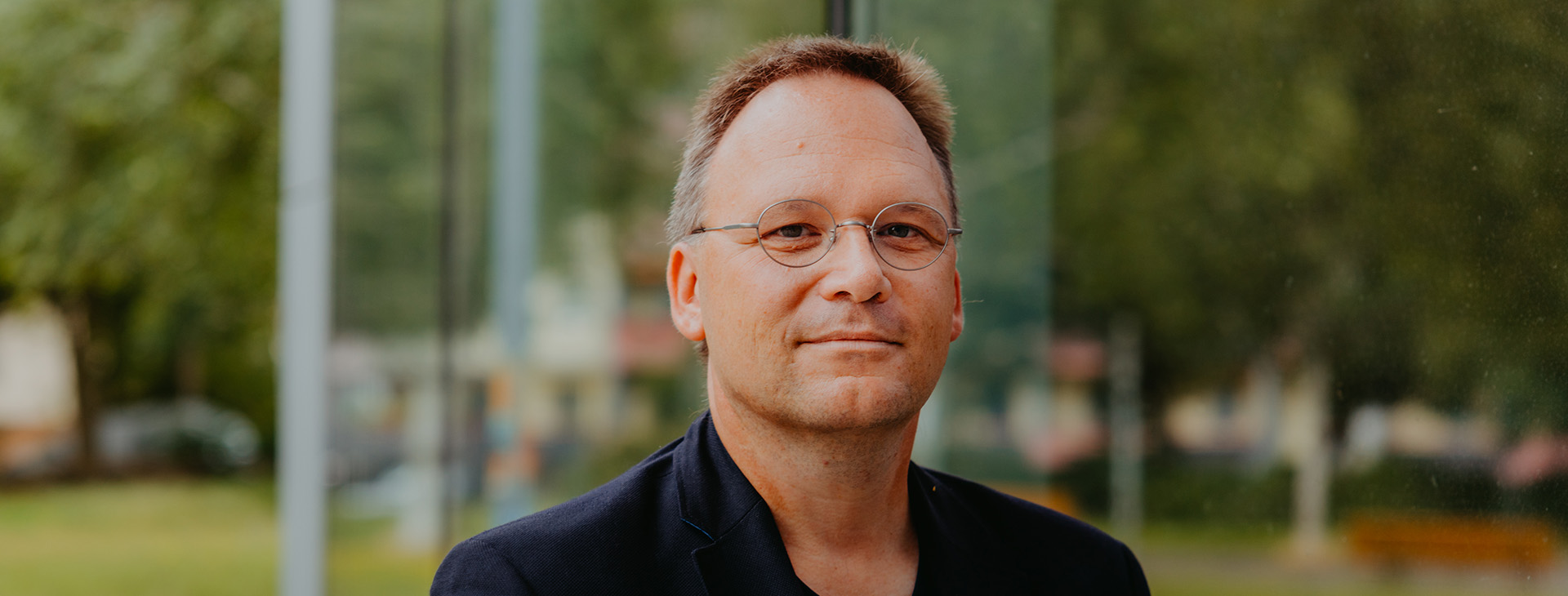
Gaining insights is only half the battle; science must also be heard. Transferring research into society is one of a university’s most important tasks. But does this really work in practice? In this interview, linguist Prof. Kersten Sven Roth offers insights into what is working and where there are still shortcomings.
How well does the scientific community manage to get its knowledge across to society? On a scale of 1 to 10?
I can make it easy for myself and simply not answer the question, because we simply lack the scale; we lack the criteria for it. And science shouldn’t answer questions it can’t answer.
Science often says: ‘We don’t know for sure yet.’ This has been particularly noticeable during the coronavirus pandemic. But many people hear this and think: ‘You can’t trust them.’ Is this a misunderstanding that can never be resolved?
In any case, it is a misunderstanding – and a serious one at that. Because for scientists, not knowing is actually the driving force behind everything. If I believed I knew everything about language, I wouldn’t turn up for work in the morning. This lack of knowledge – this ‘not yet knowing exactly’ – is what drives us and ultimately justifies our pursuit of science in the first place.
At the same time, it is understandable that laypeople look to science for guidance and reassurance. After all, that is what we ourselves want in all the areas where we are laypeople – in all the other sciences, that is. So there is nothing illegitimate about this, but it does not sit particularly well with what science is actually capable of achieving.
Virologists have probably experienced this most painfully in recent years. A few years ago, here in the Department of Linguistics, we carried out a project on the media communication of virologists during the COVID-19 pandemic, in that highly politicised context. We were able to demonstrate quite clearly just how difficult this is. And indeed, the scientists who were active at the time have themselves described, in hindsight, that they had underestimated this challenge.
As a linguist, you look very closely at how science is talked about. What do you notice in this regard that others don’t even pick up on?
In fact, the problem of science communication is often viewed primarily through the lens of comprehensibility – that is, on the assumption that we have difficulty making people understand what we do. But that’s probably not the biggest problem at all. Many of us are perfectly capable of explaining, in a reasonably comprehensible way, what we do and why we do it.
The real problem is more the shift that takes place when we step into the public sphere: the shift into a different discursive space with different rules, where something different is expected of us and where, in a sense, we also slip into a different role.
Suddenly, our personality becomes important, as does our demeanour – whether we come across as likeable or not – and much more besides. These are all things that we, in internal science communication, tend to dismiss as irrelevant – whether rightly or wrongly. These are, in fact, the greater challenges, and they are far more complex than the question of comprehensibility – which, of course, also plays a part.
Science now interacts with society and politics on many levels. Researchers sit on advisory boards, hold press conferences or explain the world on talk shows. But where do the greatest hurdles lie in these relationships, and is the growing visibility of science a success story in knowledge transfer? Or does it also bring new problems with it?
As always, the scientific-diplomatic answer is: both. It is certainly a success, but it also brings its own set of problems. It is relatively unproblematic where the focus is, in the strictest sense, on policy advice, simply because one is generally not dealing with laypeople, but with specialist politicians who possess a relatively high level of knowledge and are firmly rooted in the relevant discourses.
Things become problematic, however, in the public political sphere. This is because politics must necessarily instrumentalise science in the public sphere; there is nothing illegitimate about this, but rather it is unavoidable given the demands placed on politics. But this is, of course, something that requires careful reflection: why one is specifically called upon to express scientific views in the political arena.
So you do have to consider which talk show you’re appearing on and what that might ultimately entail.
Absolutely. You must always start by considering the media context: why does this programme exist, and what is its aim? After all, it is not only politics that instrumentalises science; the media do so too. Talk shows, for instance, are an entertainment format that relies on conflict and personalisation.
Technical language is precise, but incomprehensible to many people. Terms such as ‘climate crisis’ or ‘risk’ have a completely different meaning in science than they do in everyday life. What problems does this cause? And can the gap between scientific and everyday communication be bridged?
Yes, the problem is, first of all, that we cannot simply convey our scientific language to the outside world unchanged. That would be the easiest and most effective approach, but it doesn’t work. The precision of scientific language stems essentially from the fact that it works with terminology – that is, with defined meanings. From a linguistic point of view, a term is a word with a fixed meaning.
In everyday language, by contrast, words do not have a fixed meaning. There is a thought experiment in the philosophy of language that illustrates this: how many grains make up a heap? This cannot be answered because the meaning of ‘pile’ is not semantically defined at all. Terms do have such a fixed meaning, but this is not recognised in the public sphere. On the contrary: the same words necessarily have an open, interpretation-dependent meaning there.
So is there a divide to begin with? I would say: yes, but it can certainly be bridged by reflecting on it and, where in doubt, refraining entirely from terminological usage. Instead, one tries to think through and express things using the logic of everyday language. One might then be admired somewhat less both within and outside one’s own field – but one will be understood.
Some politicians and even the media rarely refute expert knowledge on its merits. Instead, they ridicule it or simply cast doubt on its credibility. What can scientists do about this?
First and foremost: persevere and do not conform. This applies to many areas of society, but perhaps particularly so to science.
At the same time, we should think carefully about how we can give society a concrete insight into what we do. We have a wonderful namesake for this: Otto von Guericke. For scientists and engineers, he is particularly interesting because of his scientific discoveries; for me, he is interesting above all because of his science communication. What was special about his hemispherical experiment was that he actually let people see what he was doing, rather than staying in the lecture theatre and disseminating his findings there.
I believe it’s very important that we do exactly that, as often as possible. Because that counteracts all forms of suspicion and insinuation. There is, of course, that James Bond-style image of the slightly mad scientist who ultimately poses a threat, and this is precisely how we can counteract that. I believe we cannot do this often enough.
How, and in what context, should science be political at all?
I don’t know whether science should be political. But it is political; that is inevitable.
She is one simply by virtue of deciding what she considers worthy of research. If, for example, I develop a self-driving cargo bike, that has a great many political implications – for instance, regarding the desirable design of mobility. It’s important to realise that it doesn’t work in an ‘apolitical’ way at all.
In the human sciences, which is my background, this is of course even more the case. We deal with people and society, and that is why it is important to recognise that what we investigate scientifically has, at the very least, political consequences.
At the same time, I would say that, for the same reason, the human sciences are also the leading disciplines when it comes to reflecting on such questions. There are good reasons why no reputable university with a focus on natural sciences and engineering would do without a strong programme in the human sciences.
Podcasts, YouTube explainer videos, TikTok videos: can these formats genuinely foster a better understanding of science, or do they merely scratch the surface?
Social media held great promise when it first emerged: the hope that it would make it easier to disseminate and communicate knowledge. To a certain extent, that’s true, at least as far as specialist content is concerned: if you break it down into small enough chunks, it certainly works. The real problem, however, is that this conveys a false image of science. That’s why I now find it rather dangerous to intensify this trend any further.
If, as a scientist, I explain my findings in 30 seconds, that is placed on an equal footing with the 30-second clips of some TikToker or a Telegram group. This is dangerous, because it naturally breeds mistrust of science – after all, it can apparently explain what it does in 30 seconds. In doing so, we tend to call into question all the effort we put in and the many resources we supposedly need, rather than making their necessity transparent.
That’s why I believe: there’s no getting round social media, but we must handle it with care.
Alongside social media, we now also have AI. Is AI, then, the greatest opportunity since the invention of the internet to make scientific knowledge accessible to everyone?
AI is the next big thing about which one might think the same. And here, too, it’s true to a certain extent: AI makes knowledge and science available in a way we’ve never had before. I, for example, who know nothing about programming, can have ChatGPT programme a simple little app for me. That’s quite astonishing. At the same time, I’m not actually acquiring any knowledge through this. In the past, I would have had to ask a colleague from the computer science department to do this for me – then I would have had the app, but I wouldn’t have fancied that I’d acquired any knowledge as a result. That, to a certain extent, is precisely the illusion of AI: you have to have acquired knowledge yourself in order to be able to make use of it.
The other problem with AI, at least as we’ve known it so far, is that it reproduces patterns; it can’t do anything else, after all. We’re currently looking at this in a seminar in German Studies. And that, in fact, isn’t really the essence of science. Science is characterised, rather, by its ability to transcend patterns.
To me, ChatGPT always seems a bit like the model pupil who knows everything, but isn’t the one who can blaze a new trail or come up with something truly new ‘out of the box’. Yet that is precisely a necessary characteristic of science.
Are you therefore confident that science, society and politics will be engaging in better dialogue in ten years’ time than they are today? What developments do you foresee?
Science must be confident. Science, as we know it today, is a product of the Enlightenment. And that was precisely the appeal of the Enlightenment and the core of its success: a promise, a pledge that the world would become a better place. I believe we must continue to embrace this in science and work towards it. It won’t happen by itself.