From 1 to 6 June, the Eco-Social University Days will transform the University of Magdeburg campus into a hub for exchange, discussion and engagement. The programme features numerous events on climate, sustainability and democracy. In an interview with editor Lisa Baaske, students Florian and Lena from the organising team reveal what highlights visitors can look forward to and just how much work goes into organising such an action week.
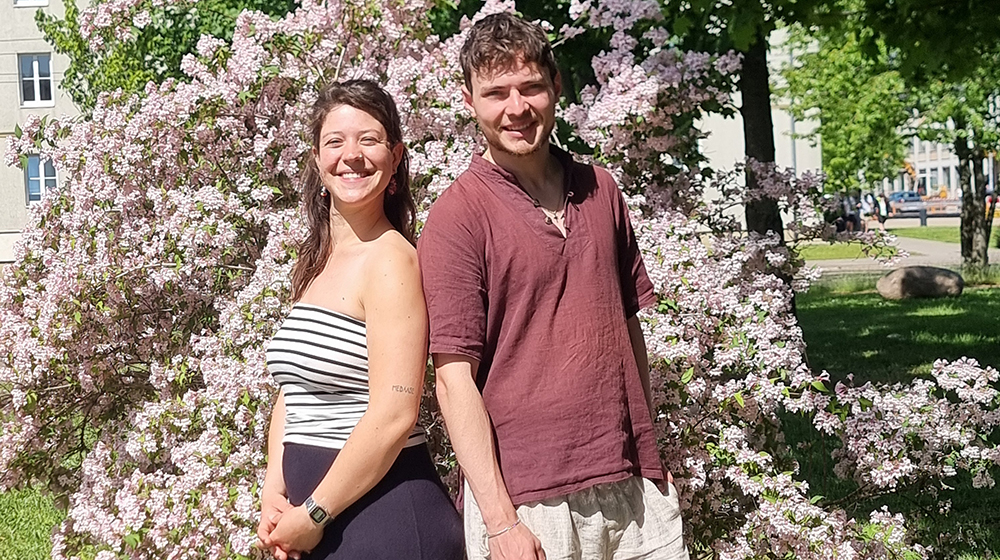
What are your names, how old are you, and what are you studying?
We are Florian, 23 years old, a psychology student, and Lena, 24 years old, studying for a Bachelor’s degree in Social Sciences.
What exactly are the ÖSHT? This is the 13th time they’ve been held, isn’t it?
Lena: The Ökosoziale Hochschultage (ÖSHT) are a series of events aimed at fostering both theoretical understanding of issues and practical knowledge for action – in other words, raising awareness of various aspects of sustainable development and major global challenges. Each year, we choose a different focus and devise a programme on the topic that is as varied as possible.
Who are the ÖSHT aimed at?
Florian: Anyone who is interested, wants to learn something new and simply wants to have a good time meeting new people.
Why are you involved with the ÖSHT?
Lena: The ÖSHT offer a wide range of events on various topics that address problems and solutions and facilitate discussion. These issues are personally important to us and we want to create spaces where people can exchange ideas and, perhaps with new inspiration, make the world a better place.
What have been the biggest hurdles in the planning so far?
Lena: Time management – the days are flying by incredibly quickly and the week is coming round much faster than expected. We want the days to be enjoyable for everyone and I’m sure they’ll be great fun. Nevertheless, we’ve had to assess which brilliant ideas we can actually implement within our time and capacity, and which ones need to be saved for other projects in the future.
What was your personal ‘aha’ moment?
Florian: My ‘aha’ moment was when I was filling in the applications for the Student Union and realised that my initial panic about time-consuming bureaucracy was overblown and that it is actually doable. If you make a mistake, the Student Union politely points it out to you – a positive experience of collaboration.
How much time goes into organising a week like this?
Lena: A great deal – no one could pull this off on their own, which is why the team has done an incredibly good job together. We met regularly and divided up the tasks. Given that most of us are doing this on a voluntary basis, we can be very proud of ourselves.
What exactly is this year’s focus?
Florian: This year’s 13th ÖSHT is dedicated to the theme »Climate and Democracy«. Through active dialogue, students, initiatives and other stakeholders from Magdeburg will explore how effective, equitable climate protection and democratic processes are interconnected, and what role social participation plays in shaping a sustainable future. From 1 to 6 June, lectures, discussions, workshops and creative formats will create a space for new perspectives, critical questions and joint reflection on climate justice, co-determination and responsibility.
What exactly do climate and democracy have to do with each other?
Lena: My view is that climate change and democracy are more closely linked than it seems at first glance. Democracies are fundamentally better placed to deliver effective climate action because civil society, a free press and independent courts can put pressure on politicians. At the same time, climate change presents democracies with a structural dilemma: it requires long-term action, whilst electoral cycles reward short-term successes. If it is not tackled, it can destabilise precisely those democratic structures that are so vital to its resolution through resource conflicts, social tensions and extreme events. However, those who consider both crises together also recognise the opportunity: a just climate policy that includes all social groups can strengthen trust in democratic institutions and prove that democracy can overcome even the greatest challenges of our time. Climate protection and strengthening democracy are therefore not competing goals – but two sides of the same coin.
What are the highlights of the week?
Florian: There’s a wide range of events on offer, all of which interest me. But for me personally, Monday is a highlight in itself, as lots of organisations will be coming together at once and there’ll be interesting discussions accompanied by music. Also, the closing event on Saturday at In:takt, where the parties’ political programmes for the state election will be discussed during a relaxed get-together. But everything’s going to be great, so do make sure you pop along!
Why should people drop by the ÖSHT?
Lena: We hope we have something for everyone. That’s why we think everyone can learn something new, meet new people and simply have a great time. But what’s particularly important: the ‘social’ aspect of the Öko-Soziale Hochschultage focuses especially on coming together. In my (Lena’s) opinion, democracy also means critical discussion – and that’s where you come in!
This year’s ÖSHT in three words?
Florian: Exciting, unifying and educational.
Are there any plans for next year yet?
Lena: No :) But if you’d like to help us plan next time or have any ideas, please get in touch by email.