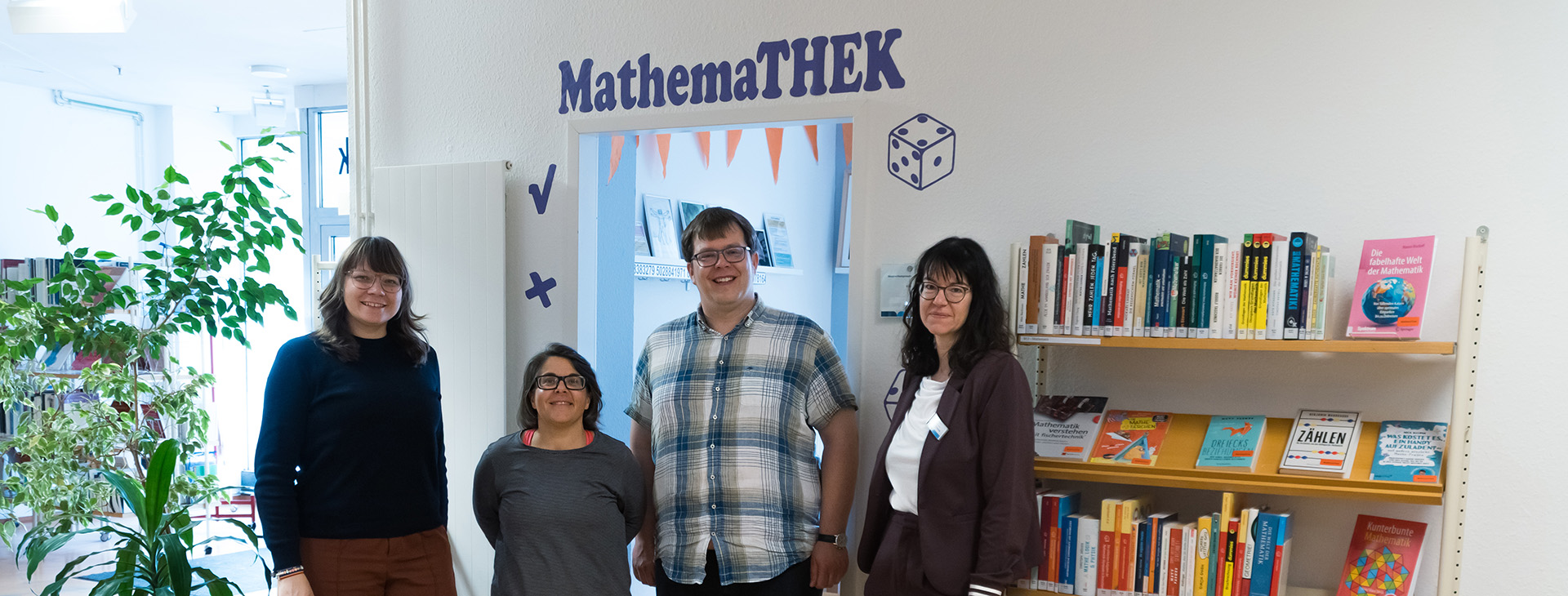
“How many drops fit on a ten-cent coin?” For a moment, there is silence in the so-called “Mathestübchen” at Magdeburg City Library. Then the children lean over the coin, count, marvel and try things out. Amidst geometric jigsaw puzzles, non-fiction books suitable for children and little experiments, it quickly becomes clear that maths can surprise, spark curiosity and pop up right in the middle of everyday life.
This is precisely what the MathemaTHEK project is all about – a learning programme that has been running at Magdeburg City Library since February. The aim is to bring maths to life in an interactive way – for children, young people and adults. The Otto von Guericke University of Magdeburg is also involved: the Faculty of Mathematics contributes its specialist expertise, helps develop content and demonstrates the diversity of mathematical thinking.
“At school, maths often puts children off because it tends to remain very theoretical. But when they realise that maths is everywhere in everyday life, they discover just how fascinating it can be,” says Christin Wegner from the Kinder forschen Foundation, which supports the Magdeburg project.
The idea for the programme came from Franziska Labitzke, former MagdeMINT coordinator for the state capital, Magdeburg. Together with Dr Ulf Friedrich from the Faculty of Mathematics, Miriam Schmidt from the City Library and Christin Wegner from the ‘Kinder forschen’ Foundation (Magdeburg Chamber of Industry and Commerce), they developed a programme that takes maths out of the classroom and brings it to a central location in the city. The City Library at the Opera House provides the ideal setting for this: open, accessible and easy to reach. The MathemaTHEK has also hosted professional development sessions for teachers. “This means the project not only has a direct impact on the learners, but is now also extending into the third phase of teacher training,” explains Labitzke, who organised the training sessions.
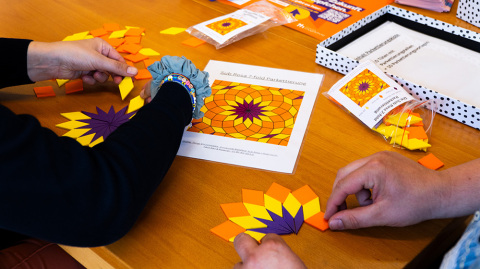
Every few weeks, the focus is on a different mathematical topic. This is accompanied by games, book recommendations, brainteasers and experiments. In the Mathestübchen, children can try out maths, really get to grips with it and discover it for themselves. At the same time, the programme is also aimed at adults. The mathematician Friedrich, for example, gives regular talks and shows where maths can be found in everyday decisions, games or movements.
Sport is a case in point: “When is it worth substituting players? How can you work out where a ball is going to fly?” says Friedrich, citing several practical applications. Questions like these show that maths isn’t just about formulas, but helps us to understand situations and make decisions.
Other academics from the university are also taking part in the programme. For instance, Prof. Thomas Kahle from the Institute of Algebra and Geometry was a guest at the city library with his live podcast ‘Eigenraum’, where he recounted the history of zero – a topic that illustrates just how fascinating mathematical ideas can be.
The MathemaTHEK is set to run until at least January 2027. Anyone wishing to contribute their own ideas for topics, experiments or talks can get in touch by email.
Article text...