
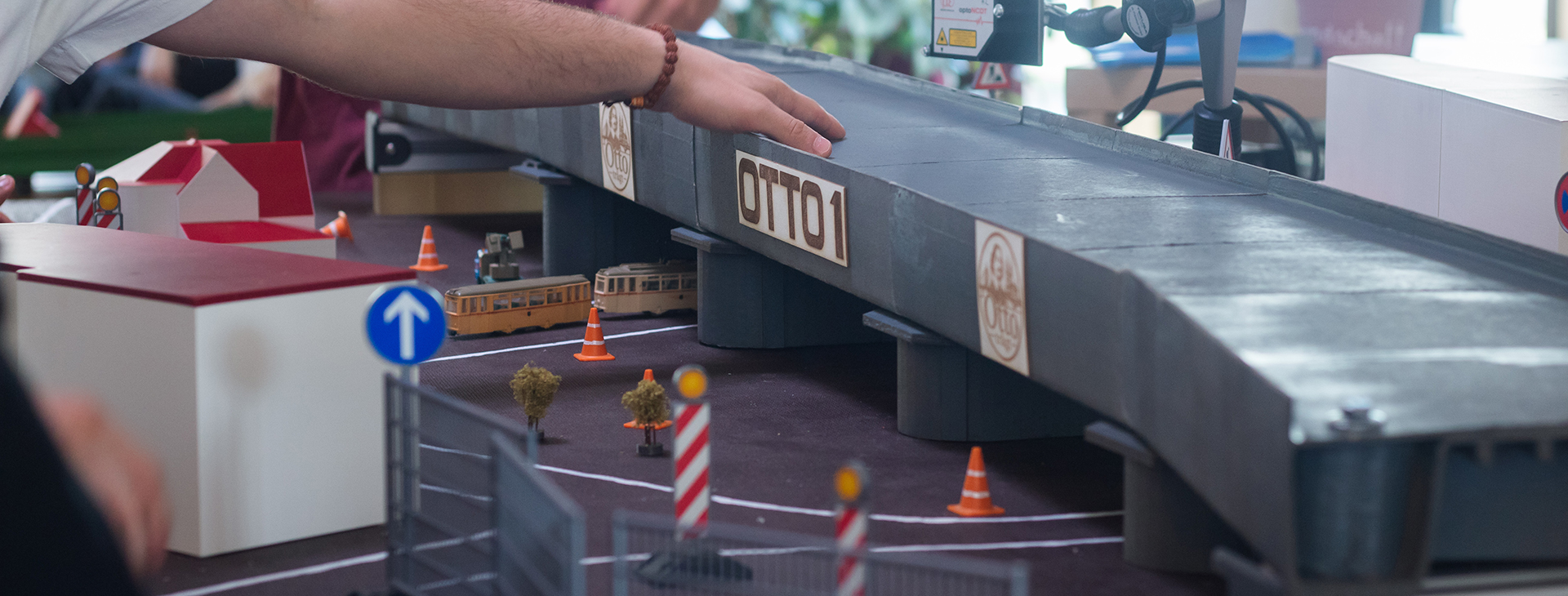
A curved road surface, supports made of compressed cardboard and a remote-controlled lorry as an endurance test: as part of this year’s PaTe project run by the Faculty of Mechanical Engineering, six student teams developed temporary bridges for the damaged section of the ring road between Halberstädter Straße and Hellestraße. In July, their designs were finally put to the test in a head-to-head competition.
The competition marked the conclusion of the ‘Team Project Work’ (PaTe) module. As part of this, Bachelor’s students from the Faculty of Mechanical Engineering tackle a practical engineering task each semester, from the initial idea through to calculations and the finished prototype.
“The students first develop various approaches, calculate their designs and then put them into practice. It is only during the final challenge that it becomes clear how well the different concepts actually work,” explains project supervisor Sacha Sobotta, a research assistant at the Chair of Metallic Materials. “This allows them to experience first-hand how theoretical considerations stand up to the test in practice.”
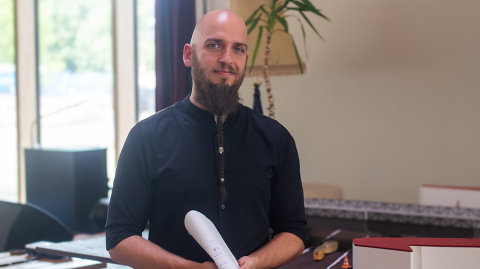
The current bridge project
This year, the six teams were tasked with designing a temporary bridge for the demolished section of the ring road between Halberstädter Straße and Hellestraße. “The bridge was chosen as the thematic starting point because, given the current situation in Magdeburg, it represented a practical and everyday topic,” reports the project manager. “The surroundings were recreated on a scale of 1:87. To this end, the City of Magdeburg provided geodata, including the relevant elevation measurements. The road layouts were created on the basis of this data. The Studi-Lab student workshop at the Faculty of Mechanical Engineering added, amongst other things, the surrounding buildings, trees, a tram, the construction site facilities and the remote-controlled lorry,” says the project supervisor.
The local conditions made the task particularly challenging. “The two connection points are at different heights and are also on a slope,” explains Sacha Sobotta. “Furthermore, the route runs along a curve. The bridges had to be wide enough for the model lorry, and the students were only allowed to place their supports at specified positions.”
Paper instead of steel
The structures were built exclusively from paper and cardboard – deliberately unusual materials for budding mechanical engineers. “We wanted to use a material that was largely unfamiliar to the students from their studies so far,” says Sacha Sobotta.
Before the teams could begin construction, they therefore first had to investigate the properties of their material themselves. Through tensile, compressive and bending tests, they determined the load-bearing capacity of the various types of paper and cardboard and subsequently used the results for their designs.
This came as a surprise to many. “The load-bearing capacity of paper was often significantly underestimated. Even small samples achieved astonishingly high values in the test laboratory.”
The big load test
At the closing event, the bridges had to demonstrate what they were capable of. First, they were tested under the specified design load of around three kilograms – the weight of the model lorry. The structure was allowed to deflect by no more than two millimetres. The deflection was measured non-contact using a laser.
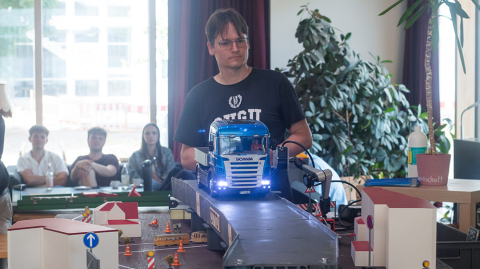
As well as stability, the bridge’s own weight also played an important role. This is because a lightweight structure is often regarded as particularly efficient in engineering. Minimal deflection was therefore not automatically an advantage; it could also indicate that a bridge had been built unnecessarily heavily.
The real surprise came during the competition itself: the load was gradually increased to nine kilograms – three times the intended load – whilst the remote-controlled lorry drove across the bridges.
Lightweight yet stable
Team three won the competition. Their bridge was the lightest structure in the field and, at the same time, exhibited the second-lowest amount of deflection. “Above all, the slender supports played a decisive role in reducing the weight,” explains Sacha Sobotta.
The winning team consisted of ten students from various study programs, including Mechanical Engineering, Industrial Engineering with a specialisation in Mechanical Engineering and Logistics, and AI Engineering.
“From the outset, our aim was to build a bridge that was as light as possible whilst still safely supporting the required load,” says team spokesperson Vincent Luthe. Working together, the team first developed the basic concept and then continuously optimised the design using digital modelling.
The production of the supports was particularly labour-intensive. Using 3D-printed moulds, the students pressed paper and cardboard together with adhesive to create components with exceptional load-bearing capacity. The curved deck also required a great deal of precision when cutting and gluing.
Teamwork pays off
Vincent Luthe has particularly fond memories of the moment when the lorry finally drove across their own bridge. “We were incredibly anxious to see whether our structure would hold. When the lorry actually drove across it without any problems, the relief was immense.”
For the bachelor’s student, the key to success lay in a simple concept. “Sometimes less is more. Our comparatively simple design was easy to build, and we were able to keep improving it throughout the project.”
However, he said that another experience was even more important than winning the competition. “The main thing we’ll take away for the rest of our studies is how important good teamwork is. Through constant dialogue and joint discussions, we were able to keep refining our ideas. That was at least as valuable as the victory,” the student concluded.
This year’s PaTe project was supervised by Prof. Thorsten Halle, Head of the Chair of Metallic Materials at the Institute for Materials, Technologies and Mechanics within the Faculty of Mechanical Engineering.


