
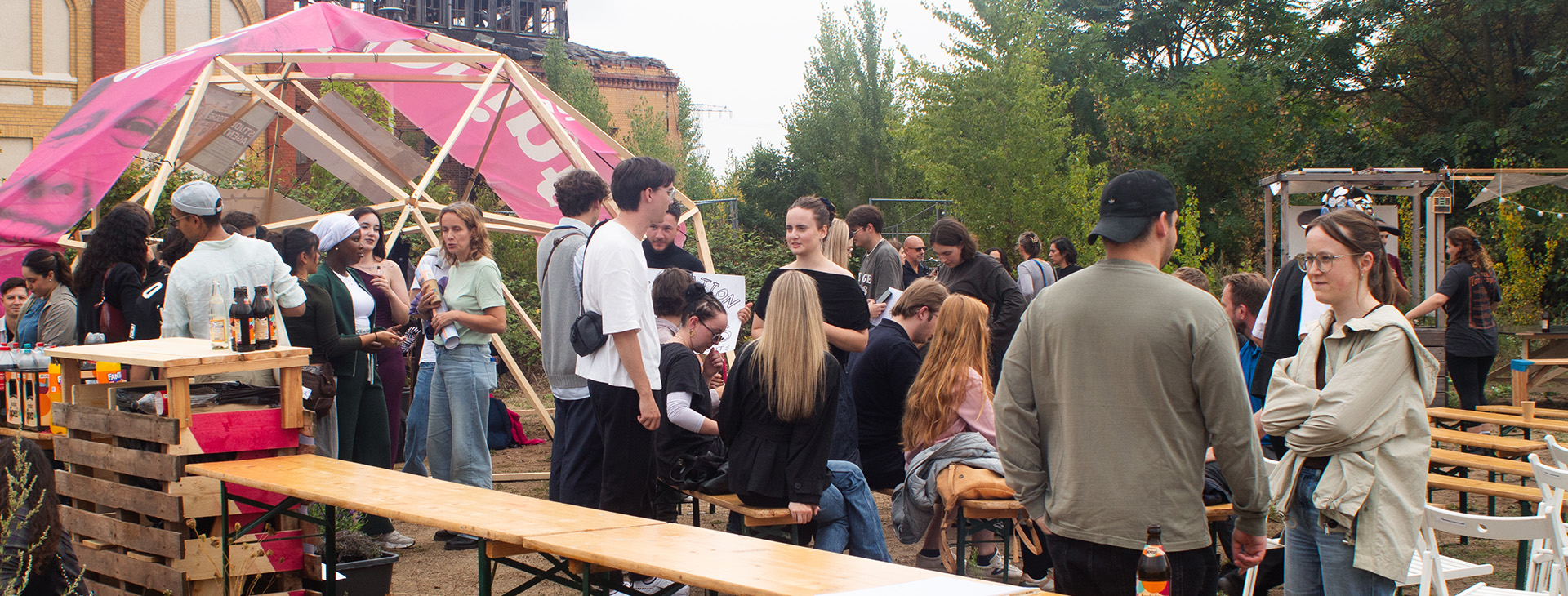
Vacant plots, old industrial buildings and plenty of scope for new ideas: Magdeburg’s Wissenschaftshafen is still undergoing transformation. At the same time, the site belongs to Otto von Guericke University, even though many students have so far hardly regarded it as part of their own campus. What might this place look like in the future? Where could people work, meet or spend their free time together? And how can students themselves play a part in the development of the Wissenschaftshafen?
In August 2026, nearly 60 students from various disciplines explored these questions at the international URBAN UTOPIA Summer School. Participants from eight EU GREEN partner universities travelled to Magdeburg for the event and jointly developed concepts for the future use of the Wissenschaftshafen. “I wanted to create something that is interdisciplinary and transdisciplinary, and which offers opportunities for students to contribute their visions, ideas and opinions,” explains Jana Richter. She is the head of the Media Workshop at Otto von Guericke University Magdeburg and organised the Summer School. “I had the idea of bringing together academic teaching and creative workshops to work on the topic of sustainability in an interdisciplinary way.”
The composition of the seminar and workshop groups was deliberately designed to be interdisciplinary. Disciplines represented included architecture, industrial design, computer science, environmental sciences, media education, cultural engineering, peace and conflict studies, and international business and economics. “The study programs were diverse, and that was also the idea behind URBAN UTOPIA,” explains the organiser. “The aim was for many different people from a wide range of fields to find their place in the program and work together.”
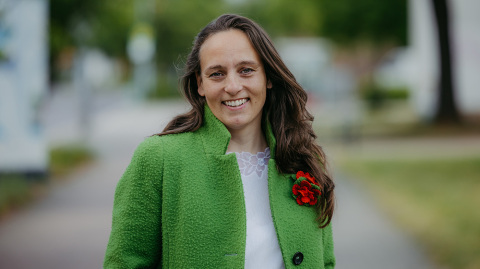
The Summer School also had a broad international reach. Participants came from eight universities in the EU GREEN higher education alliance: from Germany, Portugal, Sweden, Ireland, Poland, Romania, Italy and France. As the partner universities also have many international students enrolled, this meant that participants came from a range of other countries as well. “If I’ve counted correctly, we actually had 25 nationalities,” reports Jana Richter.
The full title, ‘Cities in the Making – Co-Creating Cultural Spaces’, is underpinned above all by the idea of involving people more closely in shaping their own environment. “Cities are often developed or redeveloped by urban planners, even though it is actually the people who live in the city,” explains the project’s initiator. “So we asked ourselves whether students or the citizens of Magdeburg could also help shape the city.”
The project focused on the Wissenschaftshafen as a specific location. The decisive factor here was, above all, the potential of the site, which is still under development. “There are still many unused areas and spaces at the Wissenschaftshafen,” explains Jana Richter. “This is precisely where the opportunity lies to try out new ideas and work together to consider how this site can be used and further developed in the future.”
The project was supported, amongst others, by the European university alliance EU GREEN, as well as by transPORT – a research and knowledge transfer project dedicated to the development of the Wissenschaftshafen – and its workshop transSCAPE, ‘Cultural Spaces of Knowledge’. Whilst EU GREEN primarily facilitated contact with international partner universities, transSCAPE contributed its expertise in cultural spatial design and the temporary use of spaces in the Wissenschaftshafen. “transSCAPE already knew who to approach and which applications needed to be submitted to the city so that we could work there at all and build something,” explains the project’s initiator.
URBAN UTOPIA took place as a so-called Blended Intensive Programme (BIP) as part of the Erasmus+ programme. Consequently, the collaboration began with an online phase even before the stay in Magdeburg. During this phase, the participants and lecturers got to know one another, chose their seminars and workshops, and explored their respective topics for the first time. “The virtual phase also involved preparing survey stations so that the views and ideas of Magdeburg’s residents could be incorporated into the summer school seminars,” explains Jana Richter.
During the on-campus phase, the students then worked daily in two different formats. “From 9 am to 1 pm they attended the seminar they had chosen, and from 2 pm to 6 pm they took part in their respective workshop,” reports the organiser. “In the morning, the focus was on academic work, whilst in the afternoon they engaged in creative activities such as drawing, writing, producing music, theatre or sport.”
The programme kicked off on 9 August with the ‘Family First’ event. During a treasure hunt, the international students first got to know the Wissenschaftshafen better and got to know each other. To this end, groups were deliberately put together with participants from different countries. “It was a team-building exercise,” explains Jana Richter. “It was important to us that the students came into contact with people from different countries right from the start and tackled tasks together.”
At the same time, the treasure hunt took them through the Wissenschaftshafen. The aim was for participants to familiarise themselves with the site first, before developing their own designs for it. At the pre-arranged survey points, residents of Magdeburg were also able to share their ideas. “What’s missing from the Wissenschaftshafen? How could rainwater be used? What’s needed to work in green surroundings?” says the organiser, describing the questions. “With the planned outdoor office, for example, the focus is on whether respondents consider electricity, shade or greenery to be particularly important.”
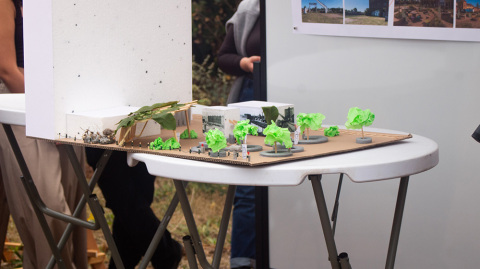
The responses from Magdeburg’s residents gave rise to a wide variety of ideas during the Summer School. One example is the Science Port Playground. Three female students developed a play and social space for this project that deliberately draws on the industrial history of the Science Port. The central element of the design is a play structure in the shape of a harbour crane, which combines climbing, sliding and swinging. Smaller play elements, as well as seating, hammocks and play tables, are intended to ensure that the space functions not only as a place for children, but also as a meeting place for people of all ages.
The ‘Be Young and Free’ design took a different approach. For this, the students focused on the site of the open-air railway museum and considered how a meeting place for teenagers and young adults could be created there. The plans included, amongst other things, seating areas, a barbecue area, covered areas, a graffiti building, toilet facilities and a viewing point for observing nature. At the same time, the aim was to incorporate existing trains and buildings in order to preserve the history of the Science Harbour.
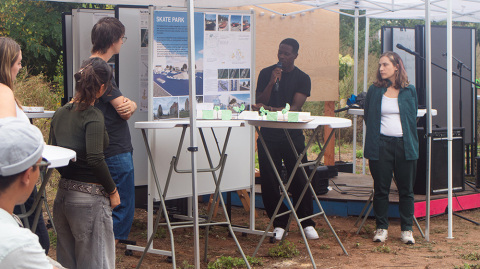
A skate park was also part of the proposed future designs. The aim was not merely to create a space for skaters, but a new meeting place for teenagers, students, local residents and visitors. The central element of the design is a ship-shaped skate area approximately 50 metres long, intended to evoke the harbour’s maritime past. Seating, shaded areas, water features, music zones and catering facilities complement the concept. A two-storey area at the rear end of the ‘ship’ could also provide shelter from the sun and rain and be used for concerts or other events.
In addition, other groups looked at topics such as water management in the Science Harbour, how families use the site, or what the area might look like in 20 or 30 years’ time. “In the area of water management, for example, two models were developed showing how water can be saved and distributed,” reports Jana Richter. In the seminar “Human Rights in Sport”, the participants developed new ideas for games. “It’s not about competing against one another, but about creating something together.”
One project didn’t remain merely a draft or a model. An outdoor office was actually built on Sandtorplatz during the Summer School. “It’s a place where you can work and brainstorm, not just on your own but also in groups,” explains the organiser. “But you can also hold presentations, readings or concerts there, enjoy your lunch surrounded by greenery, or play table tennis.”
The individual components can be arranged in different ways depending on how they’re used. The aim is for the workspace to double as a meeting place. “The outdoor office isn’t just an office, but a meeting place where people enjoy going,” says the project initiator. “You can breathe in the fresh air there or simply clear your head.”
On 19 August, the results were finally presented to the public at the AHOI ZUKUNFTSHAFEN festival on Sandtorplatz. The event kicked off with the inauguration of the outdoor office. Afterwards, the individual seminar groups presented their projects, models and visions for the future.
The creative workshops also showcased their results. Among the things on display and to be heard were linocuts, theatre, creative writing and music produced during the Summer School. “The idea behind the linocut exhibition was to ‘offer art to take away’, so that people there could simply take home any pictures they liked,” recalls Jana Richter.
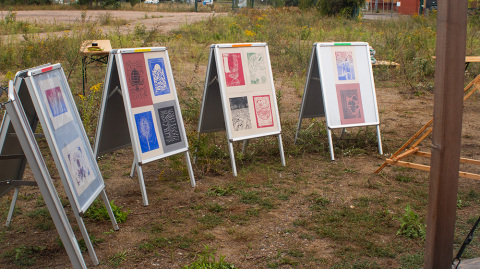
The public presentation was an integral part of the concept. “It was important that the results were shown and didn’t simply disappear into a drawer,” explains the project organiser. “Everyone should present what they had worked on, explain it, answer questions about it and thus engage with the public.”
Even after URBAN UTOPIA has come to an end, the results are therefore set to remain on display. The models and ideas will be compiled in a report and a book. Some of the work is also due to be exhibited once again in the University Library. Whether individual visions for the future will actually be realised later at the Wissenschaftshafen remains to be seen.
The outdoor office is an exception in this regard. It will remain on Sandtorplatz even after the project ends and can be used by students, staff and the people of Magdeburg. For Jana Richter, this is precisely what makes the project so valuable. “The outdoor office didn’t just remain an idea – it actually came to fruition,” she emphasises. “I’d be delighted if the space were used by lots of people in future, further developed and filled with new ideas.”
As well as the projects that have come to fruition, what has particularly stayed with the organiser is the collaboration within the international group. Students from different disciplines and backgrounds worked together on their visions for the Wissenschaftshafen. “I find bringing the world and Europe to Magdeburg incredibly valuable,” concludes Jana Richter. “I find it astonishing that this coming together of so many people worked so well in just one week.”


