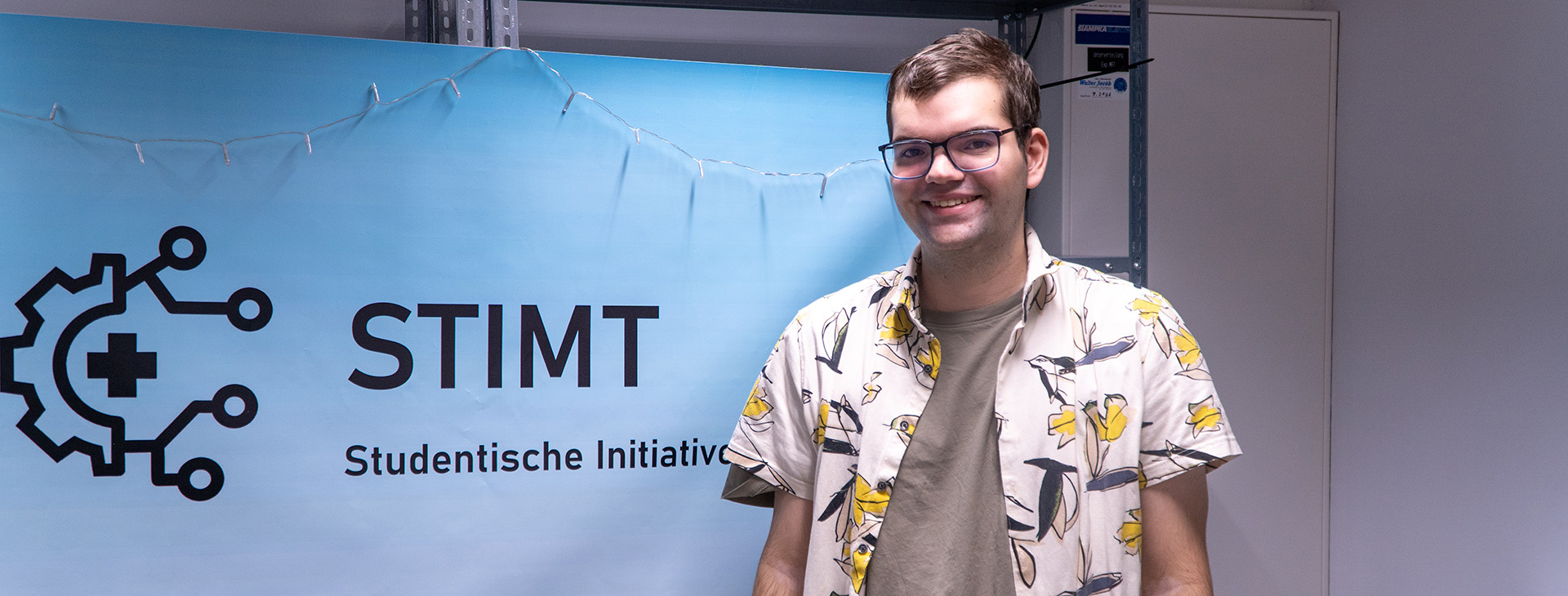
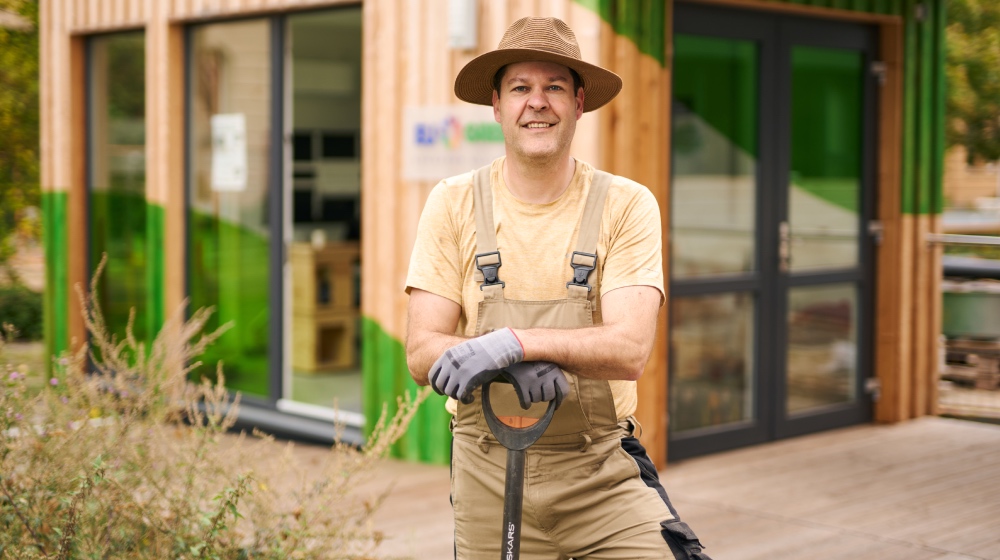
Stefan Weidner is a qualified business IT specialist. He has been working at the University of Magdeburg’s SAP Centre since 2001 and took over as its operational manager in 2009. The centre, which is now the largest of its kind in the world and employs almost 50 staff, develops and supports learning environments for more than 900 educational institutions in 86 countries. Since the start of the COVID-19 pandemic, Stefan Weidner has sought to contribute his expert knowledge actively and on a voluntary basis. As a division head in a BMBF project, he played a key role in shaping the prototype of the national learning platform “Mein Bildungsraum”. His involvement in this federal project eventually led to an enquiry as to whether he would be willing to support the EU GREEN university alliance, which was being formed at the time.
Even during the application phase, the computer scientist introduced the idea of sustainable IT use. Since 2023, he has been leading the “Digital Infrastructure” work package. Together with his colleagues at SAP UCC Magdeburg, he identifies and connects existing systems and services across the nine European universities in the EU GREEN Alliance. In future, every lecturer, student and administrative staff member within the network should be able to log in to the other partner universities using their local university account. “Sustainable IT thrives on the knowledge and shared use of existing infrastructure, rather than installing new hardware or software locally every time,” explains Weidner.
In addition, the IT staff member supports the EU-GREEN work package “Sustainable Campus and Wellbeing”, which is led by the Swedish University of Gävle. Alongside initiatives promoting physical activity in daily life and a healthy, international canteen menu, this has also given rise to the “Insectopia” project. Its aim is to create eutopias (Greek: “good places”) for insects on the grounds of the nine partner universities. Together with Anna von Busse and Ian Averkamp, Stefan submitted an application for an OVGU biodiversity laboratory on the Magdeburg university campus. An area measuring approximately 20m x 20m, located directly next to the EU GREEN Pavilion, is to be gradually transformed into a natural garden in collaboration with interested parties. As a nature-oriented space for participation, learning and work, it aims to show Magdeburg’s residents how insect-friendly habitats – particularly for wild bees – can be created in their own gardens or on their apartment balconies.
“Many people automatically think of the non-native honeybee when they hear the term ‘insect decline’. However, thanks to the dedicated work of beekeepers, the honeybee is not at risk of extinction. What many people don’t realise is that there are also thousands of wild bee species, which are responsible for around half of all pollination. Of the 600 wild bee species found in Germany, around half are threatened with extinction or critically endangered,” explains Stefan Weidner. Since summer 2025, the computer scientist has been working with a core team of EU GREEN members from the OVGU and interested Magdeburg residents on the implementation of nature modules. Stefan is the team leader and is delighted that two modules have already been created: one for nutrient-rich soil, a so-called ‘rich meadow’, and one for mineral substrate, a ‘poor meadow’, which provide not only insects but also food and nesting sites for reptiles, birds and small mammals.
The business IT specialist developed a passion for natural gardening during the coronavirus pandemic. In his own garden, Stefan is gradually transforming the high-maintenance sports and play lawn into various insect-friendly biotopes. “A frequently mown lawn may appear aesthetic and natural to the human eye, but for pollinating insects it is just as worthless as a concrete surface. Our wild bees find neither pollen nor nectar there, nor any places of refuge. Furthermore, they only recognise native plants to which they have adapted over the course of evolution. Alongside monocultures in agriculture, cherry laurel, forsythia and thuja, as well as any plant with double flowers in one’s own garden, actively contribute to species extinction,” explains the volunteer EU GREEN staff member.
In 2026, too, the people of Magdeburg are to be shown – either actively in workshops or passively through a free visit to the OVGU Biodiversity Lab – how easily they can turn part of their garden into a low-maintenance nature observation spot and thus take personal action against insect decline. In the spring, a sandarium for wild bees that nest in the ground and a so-called beetle cellar are to be created to encourage people to replicate them at home. “The total area of all gardens in Germany roughly corresponds to the size of Germany’s nature reserves. If just a fraction of these were redesigned, biodiversity could be promoted in a sustainable way,” explains Weidner. As many wild bees have a foraging range of only a few hundred metres, the multitude of such human-created ‘stepping-stone biotopes’ helps to spread and strengthen native insect populations.
During the first six months, two further initiatives have already emerged from the Biodiversity Lab. The art installation “Green Chairs” bridges the gap between human and animal perspectives on nature, beauty and utility. The BioUniversity project enables Magdeburg residents to identify and map plants using an app, highlighting local biodiversity – or indeed its absence. Furthermore, collaborations with the university garden MagdeGrün e.V., the Magdeburg Wild Bee Alliance and IkuGa e.V. promote professional exchange, the networking of existing communities and the dissemination of information to the wider public.
* EU GREEN is an alliance of nine European universities. The alliance aims to promote sustainability in education, research, innovation and society.