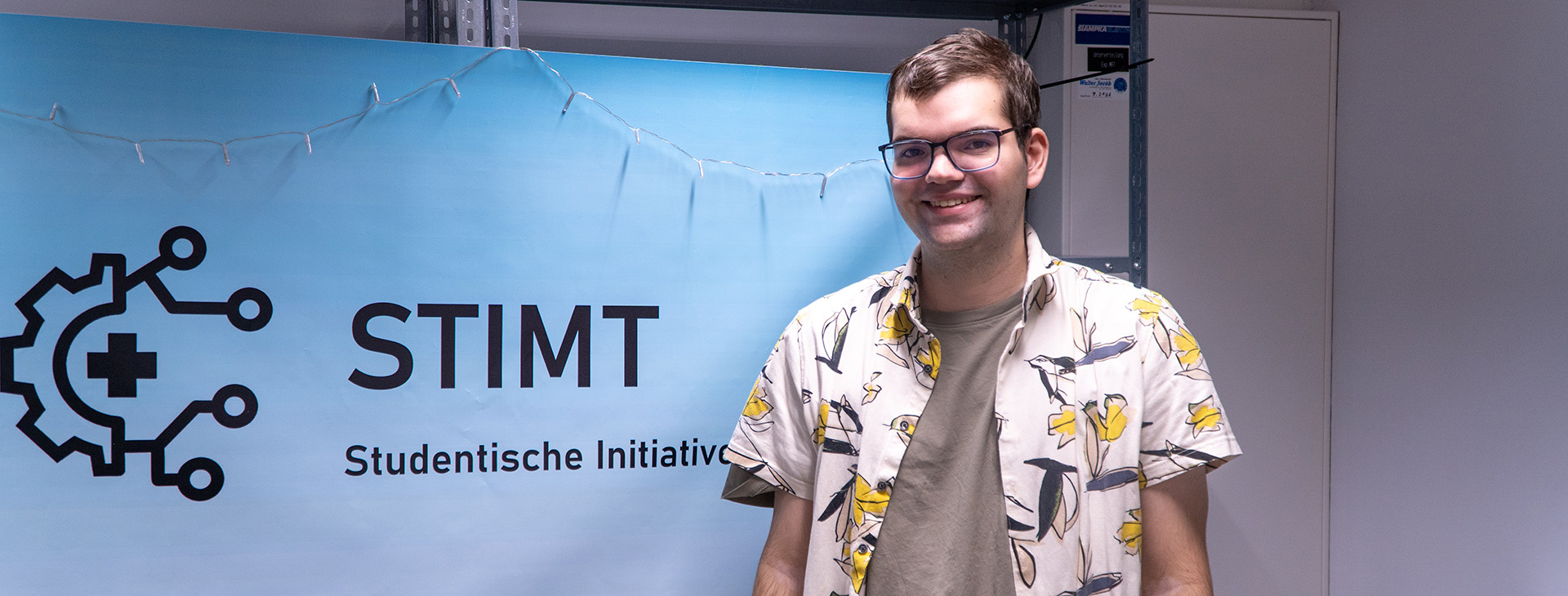

Dr Sebastian Gugel has had a day of intensive discussions. He is the Head of Medical Affairs at RAYDIAX. He is responsible for liaising with clinical development partners and potential users of the Therapy Assistance Computed Tomography (TACT) scanner – TACT is the abbreviation for the device developed and manufactured by RAYDIAX. It is the first of its kind in the world. RAYDIAX is now on the cusp of moving from technological development to clinical application.
“We are in the critical phase on the path to admission as a medical device,” says Sebastian Gugel, adding that the physicists, technicians and computer scientists at RAYDIAX are working with great focus to ensure that the TACT meets all the relevant requirements. The device has already attracted attention from experts worldwide: minimally invasive cancer procedures can be carried out within the CT scanner. “Procedures are already being performed in CT scanners. But our CT scanner was developed specifically for this purpose,” explains the medical technician. Sebastian Gugel was a PhD student at the STIMULATE research campus when the current RAYDIAX management team, led by Thomas Hoffmann, came up with the idea of setting up a spin-off to be the first to establish themselves in this market niche.
RAYDIAX was then founded in 2022. ‘X-Ray’, the term for X-rays, is part of the company name, as is ‘Radiation’, the English word for radiation. This is because: a crucial factor for a computerised tomography (CT) scanner in an operating theatre is the greatest possible reduction in X-ray radiation compared with previous CT systems. This is a health and safety measure for both clinical staff and patients.

Pre-clinical prototype has been undergoing testing since 2024
Financial security during the initial start-up phase of this cost-intensive venture was provided by millions in funding from the federal government’s EXIST Research Transfer Programme. In addition, business angels are investing their money and placing their trust in the project to establish a completely new category of devices for minimally invasive cancer therapies.
In 2024, the first TACT device was set up on the campus of Otto von Guericke University Magdeburg. Since then, the pre-clinical prototype has been tested by doctors and radiologists from the USA, Europe and the STIMULATE network in Germany – for example, using phantoms simulating lung and liver cancer. “Feedback from future users is important for the further development of the device’s functionalities. To this end, it has now been taken apart and reassembled several times,” explains Sebastian Gugel, standing in the laboratory where the TACT is currently back on the ‘test bench’ without its (now designed) outer casing.
Now visible is the gantry – the term for a kind of drum that rotates at high speed around the patient table. All the systems required for the imaging chain in therapeutic applications are attached to the gantry, enabling the surgeon to position and guide the instruments with precision in order to heat the tumour tissue to destructive temperatures of 60 to 90 degrees within a precisely defined area.
The electronics developed by RAYDIAX combine, for the first time, 3D multi-slice imaging with 2D angiography, in which the blood vessels are visualised using a contrast agent. The gantry rotates once every second and delivers 1,000 images per rotation to a computer, which transmits them as a live feed to the surgeon’s computer. RAYDIAX has also developed the specialised software for this in-house.
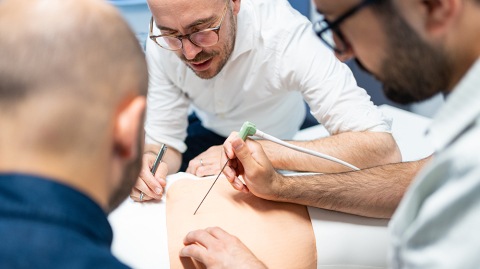
University Hospital to use TACT for clinical trial
To prepare TACT for first-in-human trials, RAYDIAX received seven and a half million euros this spring. Five million were provided by investors from Saxony-Anhalt, whilst two and a half million came from the EIC Accelerator. This EU programme specifically supports companies with disruptive innovation projects and high scalability potential. RAYDIAX is using the funds to finance the transition of TACT to its next phase of development: its first use in humans. “Mind you, this is within the context of the clinical trial,” emphasises the Head of Medical Affairs. Clinical evidence – that is, scientific proof of the device’s efficacy, performance and safety – is essential for certification as a medical device.
Sebastian Gugel outlines what is currently being tested and documented to ensure the TACT is approved for the clinical trial: the X-ray dose, for example, must be adhered to; the software must function consistently; and image quality must be consistently guaranteed.
“Electromagnetic compatibility is just as important,” emphasises Sebastian Gugel. “The TACT and a ventilator standing next to it, for example, must not interfere with one another,” he says, drawing a parallel with RAYDIAX’s most recent business success. Magdeburg University Hospital, a clinical partner from the very beginning, will install the first TACT for the planned clinical trial. “One of the co-initiators of our innovative CT system and the founding of RAYDIAX was Prof. Dr Maciej Pech, Head of the Department of Radiology. He has always supported us and will now treat the first patient using the TACT as part of the clinical admission process,” emphasises Sebastian Gugel. Funding for this was recently secured.
“This success is also the result of the attractive framework conditions within the STIMULATE network, as well as its positive external impact,” Sebastian Gugel highlights the excellent research infrastructure that has developed in Magdeburg’s Wissenschaftshafen under the umbrella of STIMULATE and in the vicinity of the research campus, which ‘encourages’ medical technology companies to establish themselves here in close proximity to university research.
TACT meets an interested market
TACT is set to be launched on the market as soon as possible, as treating doctors’ interest in such a therapy-assistance CT is growing. Sebastian Gugel mentions the COLLISION trial. It confirms the establishment of minimally invasive thermal ablation as a new standard of care. Data have shown that both open surgery and minimally invasive therapy for liver metastases from colorectal cancer offer the same chances of recovery; however, the interventional treatment is associated with less pain and fewer complications. It shortens the duration of the operation and the hospital stay, and the recovery process is significantly faster. “The therapy-assisted CT scan will provide relief not only for patients and medical staff, but also for hospital facilities,” says medical technician Sebastian Gugel.