
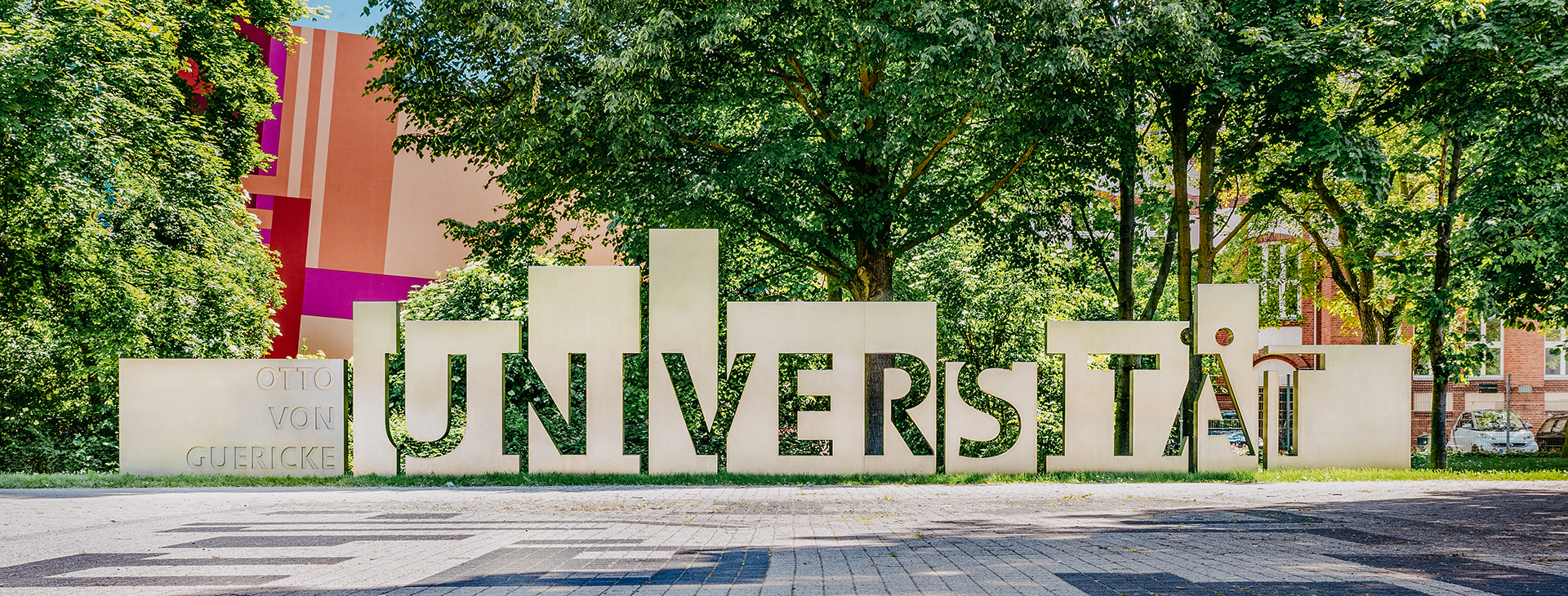
With the adoption of the Higher Education Development Plan (HEP) 2026–2030, Otto von Guericke University Magdeburg is setting itself a strategic compass for uncertain times. In an interview, President Prof. Dr.-Ing. Jens Strackeljan explains why ‘carrying on as before’ is not enough, why the university must think more in terms of networks, and how the success of this new course can be measured.
WHY THIS PLAN NOW?
Professor Strackeljan, the university development plan does not paint a picture of a comfortable future, but rather of a university under pressure. What, at its core, is the key challenge of the coming years?
As a university, our task is to remain high-performing in every respect: in study and teaching, in research and knowledge transfer. This is what sets us apart from non-university research institutions. We must therefore maintain a reasonable level of provision, attract young people to these programmes and, at the same time, conduct research that is internationally recognised.
However, the conditions for doing so are becoming more challenging: demand is falling nationwide in many STEM subjects; in Saxony-Anhalt, the number of prospective first year students is declining; competition amongst universities is growing; and the scope for manoeuvre within public budgets is narrowing. It is therefore clear that simply ‘carrying on as before’ will not lead the University of Magdeburg to a satisfactory future.
Why does the university need a new strategic compass for this?
Because we cannot simply carry on as we have done in recent years. A university development plan must not merely describe how we intend to maintain what we have achieved. If we do not change, it will not be enough.
This applies to student recruitment just as much as it does to research. In fields such as artificial intelligence, mobility, autonomous systems, process engineering, and medical and neurosciences, international competition is developing at an enormous pace. We therefore need guidance, whilst at the same time maintaining sufficient openness and flexibility to be able to respond to change.
So should this plan primarily provide direction and create a sense of bindingness, or will it be more of an imposition?
The real challenge lies right at the start: the sober realisation that we must change. After that, it is primarily about providing direction. Binding commitment arises through implementation. We will need action plans that are reviewed annually. And we will align our budget planning more closely with this plan than we have done in the past. That is a key difference from the past. When we set priorities, they must also be reflected in our decisions and the allocation of resources.
CORE CONCEPT: THE NETWORK UNIVERSITY
The key term in the HEP is ‘network university’. What does this mean?
A mission statement describes values and self-image. The Network University is more concrete. It responds to the realisation that, in some areas, we lack the critical mass to form large, world-class consortia on our own. This is not a shortcoming. It means that when initiatives require this scale, we need partners.
The Network University begins on campus. We must overcome faculty boundaries where topics are clearly interdisciplinary. Research centres such as CBBS or CDS demonstrate that such structures work. Alongside this, we need smaller network hubs where colleagues can develop ideas together. These hubs must be allowed to grow, but also to come to an end if an approach proves unsuccessful.
Does a network university also mean defining the limits of our capabilities more clearly and pooling our resources more consciously?
Yes, the network university is a clear strategic decision. We cannot achieve everything on our own. That is why we must recognise our limitations, but also our strengths; we must build on them and specifically address any gaps in our capabilities.
This applies within the university, here in Magdeburg and internationally. We have great potential in our collaboration with the neighbouring Max Planck Institute, the Fraunhofer IFF, the DZNE and other partners. Internationally, new links are being forged, for example with the University of Iowa. Our EU GREEN university alliance also demonstrates that it is not only research and mobility that benefit, but also administration, services and the development of teaching.
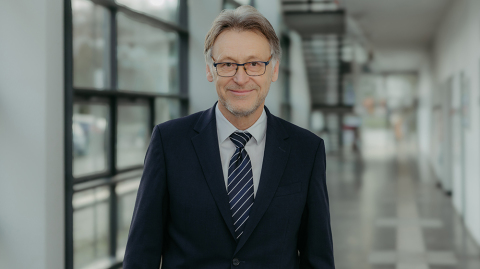
An interview with Prof. Strackeljan on the university development plan. (Photo: Jana Dünnhaupt/University of Magdeburg)
AI, DIGITALISATION AND ADMINISTRATION
What will bring about the greatest change at the University of Magdeburg in the coming years?
Quite clearly, artificial intelligence. For us, this is very tangible, for example in research into chemical processes. Here, digital twins, modelling and AI-supported methods can significantly shorten the path from experiment to application. That was one of the ideas behind our SmartProSys cluster proposal. We no longer have years to spare to realise that an approach isn’t working.
However, AI will transform not only research but, of course, teaching and administration as well, and cannot therefore be the sole concern of individual research groups. We need powerful and legally compliant tools, clear rules and structures that enable researchers, students and staff to work with confidence.
Equally fundamental, however, are demographic change, the internationalisation of our university and the question of how we will organise study, work and collaboration in future.
Hasn’t the university already lost time when it comes to using AI?
We haven’t fallen behind, but we need to move faster. AI redistributes knowledge. For us, this means we must provide a powerful AI tool that complies with legal requirements whilst at the same time protecting internal knowledge. It helps no one if staff have to experiment with random applications in their private time. Anyone expecting efficiency, better analysis and time savings must create the conditions for this. But AI will not relieve us of the responsibility to support our staff effectively. On the contrary: if routine tasks are completed more quickly, capacity can be freed up for counselling, coaching, onboarding and personal support. This is central to a network university: a network is not just a digital pathway, but a place where people get to know one another.
The HEP envisages new structures for digital teaching and AI. What are the plans?
We want to establish a teaching and learning centre that brings together expertise in digital and AI-supported teaching. There are already relevant groups and projects at the university, for example in teacher training and higher education pedagogy. These areas of expertise are to be brought together in a more visible way and act in an advisory capacity to the university.
In addition, we are considering setting up an AI centre from a research perspective. AI expertise now exists in almost all faculties. It is not a question of slapping a new label on everything, but of pooling existing strengths in such a way as to create a greater impact.
What will the HEP mean in concrete terms for the range of degree programmes on offer?
We will not be able to continue every study program unchanged. Study programs with consistently very low demand must be reviewed in collaboration with the faculties, further developed, combined with other study programs or, where necessary, phased out in an orderly manner.
At the same time, we want to create scope for new degree programmes that link the academic strengths of the University of Magdeburg with future needs for expertise and skilled workers. This is not about short-term adaptation to individual job profiles, but about an overall portfolio that remains attractive and academically rigorous in the long term.
How important is teacher training for the university’s future development?
For us, teacher training is an important university-wide task. Given the demand for skilled workers and demographic trends in Saxony-Anhalt, good schools with well-trained teachers are crucial for the future of the state. To this end, the university brings together subject-specific, subject-didactic, educational and digital expertise.
However, it is precisely for this reason that we do not wish to view teacher training as the responsibility of individual disciplines, but rather to develop it across the faculties. This involves a close link between theory and school practice, up-to-date digital and AI-related skills, as well as reliable partnerships with schools, teacher training colleges and the state. It is crucial that we not only train enough teachers, but also prepare them well for the demands of an increasingly diverse school environment.
RESEARCH, INTERNATIONALISATION AND KNOWLEDGE TRANSFER
The University Development Plan expressly commits to cutting-edge research and academic excellence. Why?
Because it is a prerequisite for future viability. Of course, the Excellence Strategy was demanding and, in the end, also a little disappointing for the many dedicated researchers. At the same time, however, it demonstrated that we can identify relevant topics and bring people together towards a common goal – and with a level of commitment that was previously almost unheard of at the University of Magdeburg.
Today, we have a clear picture of our strengths: process and systems engineering, engineering sciences, neurosciences, medical technology, cell therapies, as well as mathematical-methodological and data-driven research. We must continue to strengthen these fields. This will also require internal reallocations, as additional funding will not automatically come from external sources.
What role will international students and researchers play for the University of Magdeburg in the future?
A very significant one. Several thousand international students cannot simply be replaced by students from Germany. If we want to maintain our overall numbers, they remain indispensable.
It is therefore crucial to provide good support: with onboarding, through language courses and counselling, and with the transition into the regional labour market. If international graduates find professional and personal prospects here, that is a benefit for Saxony-Anhalt. However, this support costs money, as do scholarships and mobility programmes. We are currently strengthening these programmes considerably, amongst other things through our EU GREEN Alliance – and that needs to be funded.
The concept of ‘transfer’ is often measured in terms of patents, spin-offs and collaborations with companies. Does this understanding fall short?
Technology transfer remains central to our mission. As a university in the state capital, we bear a clear responsibility for Saxony-Anhalt’s innovation system. We must help to put technologies into practice, open up new business areas and enable spin-offs to grow. Our number of patents is respectable; however, what matters most is how we can generate greater economic impact from them. The Wissenschaftshafen and start-ups associated with STIMULATE demonstrate that research can drive growth.
Part of the Third Mission is also to anchor the university even more firmly in the city and society. Magdeburg can serve as a real-world laboratory for many topics. Those conducting research into autonomous mobility must be visible not only in computer models or on campus, but also in the city itself. To this end, we have recently significantly expanded our cooperation agreement with the state capital. This helps to build trust in science and in the importance of this university for the state. Many things are already going extremely well. Whether it’s the programme for older learners, the Children’s University, the Long Night of Science, the continuing education programmes or many other events, the university’s doors are wide open.

CAMPUS, PRIORITIES AND CULTURE
What does the University Development Plan mean for the campus as a place of learning, working and living?
At its core, the University of Magdeburg is a campus-based university. For this campus-based approach to be effective, the campus must provide reasons why it is worth being here. Some courses will continue to be delivered in a hybrid format in future. But students do not come to campus because they are forced to; rather, they come because it offers opportunities for interaction, community, sport, counselling, culture and direct academic experiences.
This is particularly important at a highly international university. University life is a phase in which people learn, experiment and build networks with a great deal of freedom. If this takes place entirely from a child’s bedroom, from another city or only digitally, something is lost. That is why campus development is not just a matter of construction or climate policy, but of what defines the University of Magdeburg. An attractive campus must be sustainable, accessible, safe and, at the same time, open to diverse life and educational experiences. For only in this way can a place be created where people from different academic disciplines, generations and countries of origin are happy to study, work and meet one another.
Not everything set out in the HEP will be possible at the same time. What criteria will be used to set priorities?
Where resources are required, it must be clear why something takes priority. That is why we need a HEP strategy group to prepare measures, link them to the budget process and provide the Senate with a basis for decision-making once a year. It is crucial that funding is not allocated according to the ‘scattergun’ principle. If network hubs are to be funded, this must be done on a competitive basis. Ideas must be viable, fit our profile and show promise of having an impact. Participation remains important, but ultimately a university also needs leadership: in the University Management, in the faculties, in the centres and in the research consortia.
However, change cannot be achieved through resolutions alone. It can only succeed if we take people with us on this journey. This means: involving staff at an early stage, providing opportunities for professional development, and explaining transparently why decisions are being made. The HEP is therefore not merely a structural and development programme. It is equally a challenge for leadership, communication and staff development.
What do you expect from the faculties, central departments, the administration, students and staff during implementation?
That they do not view the HEP as merely a document produced by the University Management. Adoption is one thing; what matters is its implementation in day-to-day life. The faculties play a central role in this, as this is where academic work takes place. Deans and other leaders are key influencers.
I expect students to actively contribute their perspectives – in committees, initiatives, teaching development and campus life. The OVGU as a network university is shaped not only by institutional cooperation, but also by the commitment of its members.
I am, however, optimistic about this, as I have encountered a great deal of willingness to do so in our discussions. This willingness must now be reflected in decisions: in collaboration across faculty boundaries, in the acceptance of priorities, and in the courage to re-examine the status quo.
LOOKING AHEAD
Despite all the strategic preparation, what is your greatest concern as you look ahead to the coming years?
The greatest uncertainty lies in the financial framework. The University Development Plan assumes largely stable conditions during the period covered by the agreement with the state. In the event of high single-digit or double-digit cuts, we would no longer be able to implement the University Development Plan under the assumed development conditions. In that case, we would first have to safeguard the university’s structural capacity and set our priorities even more rigorously.
And what is the basis for your confidence?
On the analysis and on this university’s willingness to change. A university that attracts researchers and students from all over the world to Saxony-Anhalt, applies research in the region, trains skilled workers and shapes the city as a hub of knowledge and innovation is of great value to this state. If we pool our strengths, move faster and collaborate more openly, we have good reasons to be confident.