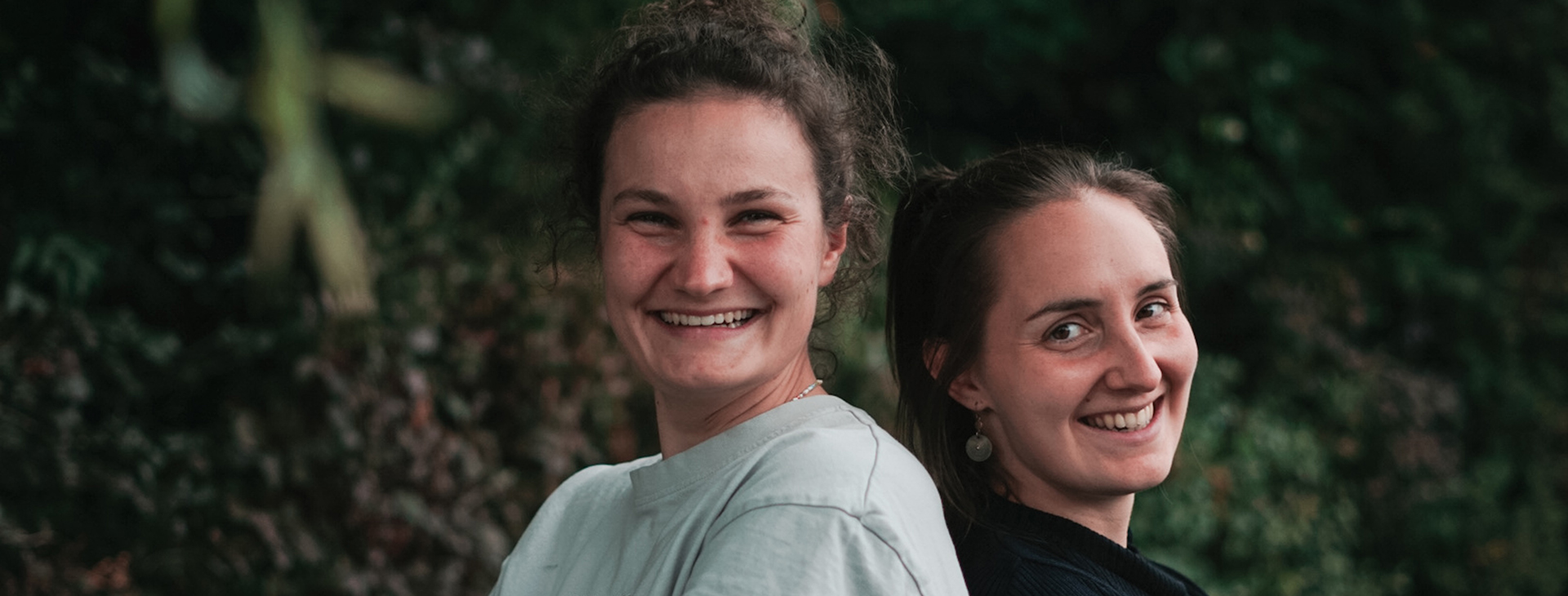

After completing her degree, Luisa Peterson had actually intended to leave Magdeburg. She returned to pursue her doctoral qualification. Now she and her research team have been honoured for a new technology for storing renewable energy.
She had actually already decided to leave Magdeburg. Luisa Peterson had given notice on her flat and, after completing her degree in Biosystems Engineering, had initially started a nine-month compulsory placement at the chemical and pharmaceutical company Merck in Darmstadt. There, she worked on estimating and modelling solubilities. However, whilst searching for a PhD position, her path led her back to the banks of the Elbe.
Luisa Peterson’s return to Magdeburg was driven by both personal and professional reasons. She had already written her Bachelor’s and Master's theses under the supervision of Kai Sundmacher, Professor of Systems Process Engineering at Otto von Guericke University. When she learnt of a vacancy at the Max Planck Institute for Dynamics of Complex Technical Systems, she recognised many of the topics that had already occupied her during her studies.
“I felt very much at home in the research group even back then,” says Peterson. “I liked the academic focus, and the job description also convinced me to return to Magdeburg.”
Peterson had previously studied biosystems engineering at the University of Magdeburg from 2014 to 2021. She had chosen this study program because it combines natural sciences and engineering. “It was precisely this interdisciplinary focus and the balance between the two fields that appealed to me,” she recalls.
During her time as a student, she was active on the faculty student council and appreciated the easy-going rapport with fellow students and lecturers. She spent almost seven years on campus, getting to know not only the university but also Magdeburg as a place to study.
Today, the 30-year-old is conducting research at the Max Planck Institute for Dynamics of Complex Technical Systems, just a few minutes’ walk from the campus where she graduated five years ago. Her research focuses on the storage of renewable energy in chemical compounds. This involves using surplus electricity from wind and solar power plants to produce chemical energy carriers. In this way, energy can be stored for long periods, transported and reused at a later date.
Among other things, Peterson is working on the CoSeCats research project. The four-person team has developed a catalyst-reactor system designed to operate reliably even when the energy supply fluctuates significantly. This is precisely what often happens with wind and solar energy. Varying quantities of feedstock enter the reactor, where they can cause sharp rises in temperature. A shell made of aluminium oxide, just a few micrometres thick, is designed to help control the heat generation more effectively and enable the process to operate with load flexibility.
“The reactors in which the conversion to chemical storage materials takes place have been known for a long time,” explains Peterson. “However, the fluctuations in renewable energy mean that the quantities at the inlet also vary. This makes it more difficult to control the heat generation. This is precisely where our catalyst comes in.”
For this work, the team was awarded first place in the Hugo Junkers Prize last June in the category ‘Most Innovative Initiatives and Projects for Adapting to Climate Change’. The State of Saxony-Anhalt presents this prize to recognise outstanding achievements in research, business and start-ups.
“Of course, we were delighted,” says Peterson. “The prize is recognition for many years of work, but also for the project and the overarching goal of making renewable energy easier to store. In this way, we want to contribute to climate protection.”
Peterson has since submitted her doctoral thesis, marking the end of her time at the Max Planck Institute. Having completed her doctoral qualification, she intends to continue working on solutions for storing renewable energy, though in future she will be based outside Magdeburg. Since August, she has been working at the Bavarian start-up Reverion. The company builds containerised power stations that can flexibly generate electricity from (bio)gas or store surplus electricity as gas. She brings with her the experience she gained during her studies, in industry and in research in Magdeburg.