When astronauts launch into space, they do not just leave Earth behind. Their bodies are subjected to an environment for which they are not designed. Muscles change, bones deteriorate, and the cardiovascular system has to adapt. Added to this is the cosmic radiation to which people are exposed on long missions. For researchers, space is an extraordinary laboratory. Under conditions that can only be approximated on Earth, it is possible to observe how human cells change and how tissues react to stress. What is researched high up in space can therefore also be of significance for people on Earth.
This is where PULSE comes in. Behind this complex project lies an international consortium that brings together expertise in bioprinting, space medicine, radiation research and cardiac research. Participants include Maastricht University, Otto von Guericke University Magdeburg, the Medical University of Graz, the Belgian Nuclear Research Centre SCK CEN, the Belgian space and technology company Space Applications Services, the Portuguese biotech firm Metatissue, the Danish pharmaceutical company RD Innovation and the Italian company IN Society. Over a period of five years – running until March 2028 – the partners aim to develop a new, almost revolutionary bioprinting technology. PULSE is funded by the European Innovation Council under the ‘Pathfinder Open’ programme with nearly four million euros. In Magdeburg, Prof. Dr. med. Daniela Grimm, Head of the Department of Microgravity and Translational Regenerative Medicine, is involved in the project alongside her team. The scientist has been investigating how human cells react to altered gravitational conditions for many years. As early as the turn of the millennium, the pharmacologist and internist began investigating cells under simulated weightlessness conditions in the context of cancer research. This revealed for the first time that three-dimensional cell structures can form – an important starting point for today’s research.

A printer for microgravity
At the heart of the PULSE project is an innovative 3D bioprinter being developed for use in zero gravity. Maastricht University plays a central role in this, where the printer is being built and the bioprinting technology further developed. What makes it special is that, unlike conventional 3D printing, the biological cells and tissue structures are not simply built up layer by layer on a surface. Instead, they are precisely manoeuvred using magnetic and acoustic forces and held in suspension. This allows three-dimensional tissue structures to be formed under conditions that are virtually impossible to achieve using conventional methods.
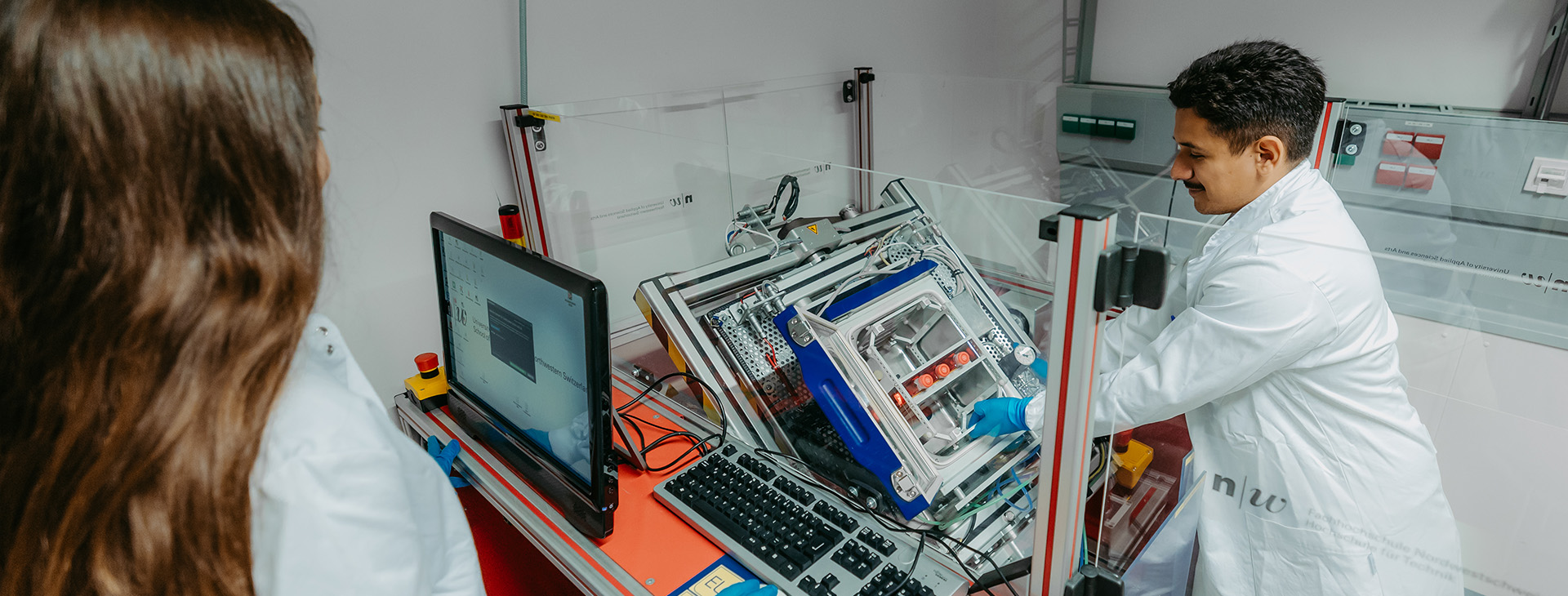
The Magdeburg research group is contributing its many years of experience with simulated weightlessness to the project. Its task is to generate tissue under these conditions and then examine it in detail. For Fernando Torres, the doctoral student involved in the project, this means, above all, spending a great deal of time in the laboratory. He helps plan the experiments, places the cell cultures under the specific conditions and then investigates what happens to them. Anyone looking into the laboratories will see equipment that continuously rotates samples in all directions. For small and light cells, this means the direction of gravity is constantly changing. This allows them to experience conditions similar to weightlessness. The researchers are using this technology to produce three-dimensional cell and tissue constructs. However, a simulation remains an approximation. “Only space can provide the gold standard for truly understanding what it is like in weightlessness,” explains Dr Markus Wehland, head of the Tissue Engineering research group. For this reason, the reference tissues developed in Magdeburg will later be compared with structures produced under different conditions using the new bioprinter. Among other things, the researchers are investigating genes, proteins and the question of how healthy and stable the cells remain.
Why a heart, of all things?
The researchers intend to conduct the ‘proof of concept’ using a piece of heart tissue. The heart serves as a relatively simple model here – a muscle criss-crossed by blood vessels, whose tissue is suitable for the planned investigations. The printed tissue samples, which are still small, are to be monitored over a period of weeks. Are the cells still alive? How are they changing? And what happens if they are exposed to additional stresses such as cosmic radiation? These are precisely the questions the researchers aim to answer.
Why are the answers important? The focus here extends beyond Earth. “The further a spacecraft moves away from Earth, the more self-sufficient it must be, because it becomes increasingly difficult to resupply it from outside,” says Markus Wehland. In the long term, technologies such as these could help in medical emergencies by enabling tissue to be produced directly on site. Skin grafts or other tissue structures, for example, would be conceivable. However, the research project is not only of interest for future journeys to the Moon, Mars or further reaches of space. The findings, for which the foundations are now being laid, could also be useful on Earth. Three-dimensional tissue models make it possible to investigate more precisely how cells age, how they react to radiation and what effects certain active substances have on them. That is why medicines are also being tested that could influence potential radiation effects or age-related changes. Prof. Daniela Grimm sees this as an opportunity: “In the long term, this could open up new possibilities for medical research. And we could help to reduce the use of animal testing.”

The countdown is on
There is still a great deal to be sorted out before the bioprinter and the cells to be studied actually fly into space at the end of 2027 or the beginning of 2028. Among other things: living cells are delicate. They need to be cultured over a prolonged period, carefully prepared and produced in sufficient quantities for the experiments. For Fernando Torres and the team, this preparation is part of their day-to-day research routine. They plan the experiments, carry them out in the laboratory and analyse how the cells react to the different conditions. The transport to space alone presents challenges for the researchers. During a rocket launch, timetables can be disrupted, and power supplies and temperatures can change. That is why research is currently also being carried out to determine what stresses the cells can withstand. Later, the researchers in Magdeburg will begin the next crucial phase of their work: the tissues from space are to be examined alongside the control tissues produced here. What still sounds like science fiction today could become reality in the future. And, of all things, weightlessness could give new impetus to research on Earth.